Rules
How to check e-bike rules on paved bike trails and rail trails
E-bike rules on paved bike trails and rail trails vary by state, land manager and corridor. Here is how to check three popular routes before you ride.
What to take away
- On the Great Allegheny Passage you ride crushed limestone through Pennsylvania, where Class 1 pedal assist fits the posted rules and throttle use is the open question segment by segment.
- The Virginia Creeper Trail crosses U.S. Forest Service land on the Mount Rogers National Recreation Area, so federal travel management governs access and shuttle operators add their own terms.
- The Little Miami Scenic Trail is paved for most of its length, one of Ohio's longest paved bike trails, and Ohio recognizes Class 1, Class 2 and Class 3, which makes it the simplest of the three for a throttle rider.
- Local rules from towns, park districts and land agencies can be stricter than state law. Confirm with the managing agency before you leave the car.
The three corridors at a glance
State
- Great Allegheny Passage
- PA, plus MD at Cumberland
- Virginia Creeper Trail
- VA
- Little Miami Scenic Trail
- OH
Surface
- Great Allegheny Passage
- Crushed limestone
- Virginia Creeper Trail
- Gravel and dirt, paved pieces near town
- Little Miami Scenic Trail
- Paved asphalt for most of the route
Who manages it
- Great Allegheny Passage
- State forest and park agencies, local trail groups, NPS at Cumberland
- Virginia Creeper Trail
- U.S. Forest Service on Mount Rogers NRA, town and county elsewhere
- Little Miami Scenic Trail
- State trail agency, park districts, town segments
E-bike answer
- Great Allegheny Passage
- Class 1 fits the posted rules; throttle use is the segment question
- Virginia Creeper Trail
- Class 1 and 2 count as bicycles in state law; federal segment follows travel management
- Little Miami Scenic Trail
- All three classes recognized in state law; check posted town and park rules
The manager column decides more than the state line does. State law sets the floor, and each corridor adds terms on top. Those terms change when the landowner changes.
Three classes, three access outcomes
| Class | Motor | Top assisted speed | What managers usually do |
|---|---|---|---|
| Class 1 | Pedal assist only | 20 mph | Permitted on most rail trails |
| Class 2 | Throttle without pedaling | 20 mph | Permitted in some states, refused on many state trails |
| Class 3 | Pedal assist, higher cutoff | 28 mph | Often limited to roads, with age and helmet rules |
The class is defined by how the motor engages, not by how hard you pedal. Pennsylvania, Virginia and Ohio all use this three-class language, though the details differ (Electric bicycle laws).
Class 3 usually carries an age floor and a helmet requirement. Pennsylvania's electric-bicycle rules are in 75 Pa.C.S. § 3504; they require Class 3 riders to be at least 16 and wear a helmet.
A modified bike becomes a different bike. Adding a throttle or removing a limiter changes how an officer reads your machine, so keep the manufacturer's label legible on the frame.
Check the state law and the land manager's rule for each segment. The relevant state-law references are Pennsylvania's Vehicle Code, 75 Pa.C.S. §§ 102 and 3504; Virginia Code § 46.2-100; and Ohio Revised Code §§ 4511.01 and 4511.522.
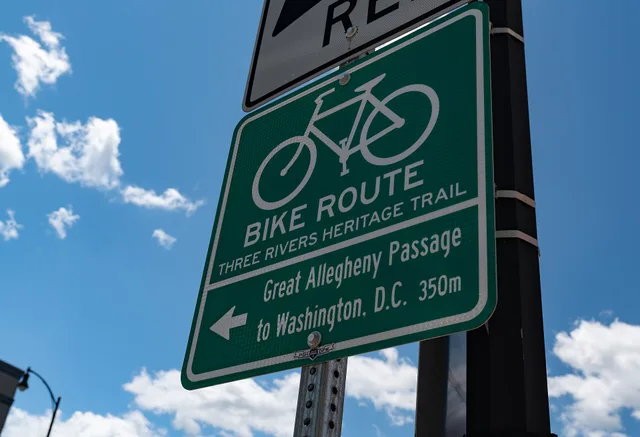
Pennsylvania: the Great Allegheny Passage
The Great Allegheny Passage runs about 150 miles from Cumberland, Maryland to Pittsburgh. The surface is crushed limestone rather than asphalt, so tire choice matters more than motor class on a long day.
The Pennsylvania part of the trail has multiple managers. Start with the Steel Valley Trail Council for Pittsburgh to Boston, the Regional Trail Corporation for Boston to Ohiopyle, Pennsylvania's Department of Conservation and Natural Resources (DCNR) at Ohiopyle State Park, and Somerset County Rails to Trails Association for the eastern sections. Check the exact segment with its manager; DCNR's e-bike policy for state forest and state park lands is a separate rule to review, especially for Class 2 throttle use.
Crushed limestone rolls slower than asphalt and punishes narrow tires. Our comparison of crushed limestone rail trails for road bikes explains what survives a loaded day.
At Cumberland the passage meets the C&O Canal Towpath, administered by the National Park Service (NPS). Check the C&O Canal National Historical Park's bicycle and e-bike rules and superintendent's compendium before crossing onto NPS land.
Virginia: the Creeper Trail and federal ground
The Virginia Creeper Trail runs about 34 miles from Abingdon to Whitetop on gravel and dirt, with paved pieces near town. Virginia Code § 46.2-100 defines electric power-assisted bicycles and their classes; check the rule for your class as well as the trail manager's restrictions.
A long stretch crosses the Mount Rogers National Recreation Area, managed by the U.S. Forest Service as part of the George Washington and Jefferson National Forests. The Forest Service Travel Management Rule, 36 C.F.R. Part 212, governs route designations; consult the Mount Rogers district motor vehicle use map (MVUM) and confirm with the Mount Rogers National Recreation Area office.
Federal agencies do not share one rule. The Bureau of Land Management treats e-bikes as motor vehicles unless a manager opens a specific route (E-Bikes | Bureau of Land Management).
Shuttle operators set their own carrying policies. Creeper Trail Bike Rental & Shuttle is one named operator; ask it directly about carrying your e-bike and its current class or battery restrictions before you book.
Ohio: the Little Miami Scenic Trail
The Little Miami Scenic Trail runs roughly 78 miles from Springfield to Newtown, near Cincinnati, and it is paved for most of that distance. Ohio Revised Code §§ 4511.01 and 4511.522 cover e-bike definitions and operation, but they do not replace trail-manager rules, so do not assume every segment allows every class.
Management changes along the route. Check with the Ohio Department of Natural Resources for Little Miami State Park sections, and with Greene County Parks & Trails, Warren County Park District, or Clermont County Park District for the sections each manages; local rules may add restrictions.
State trail maps mark which agency holds each segment, but the map is not the e-bike rule. For an Ohio segment, identify the manager and check its posted rule as well as Ohio Revised Code § 4511.522. Our notes on reading Ohio DOT trail maps show what to look for before you plan daily mileage.
The corridor connects to the Ohio to Erie Trail, which reaches Columbus and Cleveland. The state rule travels with you, the local overlay does not.
Confirming access before you ride
Twenty minutes of checking protects a whole trip. Work from the segments you will actually ride.
- Mark the manager for each segmentuse the Great Allegheny Passage trail partners named above, the Mount Rogers National Recreation Area office for the Forest Service section, or the relevant Ohio agency or park district.
- Check your bike's class on the manufacturer's label, then consult the applicable state code: 75 Pa.C.S. §§ 102 and 3504, Virginia Code § 46.2-100, or Ohio Revised Code §§ 4511.01 and 4511.522.
- Read the manager's posted rule. For Pennsylvania state forest and state park land, check DCNR's e-bike policy; for the Forest Service section, check the Mount Rogers MVUM; for the Little Miami, check the relevant agency or park district's rule.
- Contact that manager and, if using a shuttle on the Creeper Trail, the shuttle operator. Ask about your class, route, and any local restrictions.
For state-level questions, the Federal Highway Administration's public list of State Bicycle and Pedestrian Coordinators is a useful second contact (State Bicycle and Pedestrian Coordinator - Bicycle and Pedestrian Program - Environment - FHWA). For the controlling rule, use the official state code and the trail manager's own policy or posted rules.