Guides
Planning a car-free cycling weekend around Amtrak bike roll-on routes
Plan a car-free cycling weekend on Amtrak bike roll-on routes, with named stations on the Great Allegheny Passage and the Erie Canalway Trail.
What to take away
- The bill has three partsthe train fare, the bike fee and the bed. Lodging is usually the biggest and the least flexible.
- Pittsburgh, Cumberland, Washington, Albany-Rensselaer and Buffalo-Depew are the five stations that carry the most car-free weekends in the East.
- The Great Allegheny Passage runs about 150 miles on crushed limestone; the Erie Canalway Trail runs roughly 360 miles on stone dust and asphalt.
- Book the small-town room before the ticket. Trail-town lodging sells out faster than bike space does.
- Carry one fallback train, one bailout town and one taxi number saved offline.
What car-free actually requires
Four things have to line up: a station, a train that carries a bike, a trailhead you can reach without a car, and a bed near the trail. Miss one and the weekend becomes a taxi problem.
Car-Free Weekend Requirements
- Station with train service
- Train that carries a bike
- Trailhead reachable without a car
- Bed near the trail
Start with the train, not the trail. Amtrak sells roll-on space per departure, and equipment changes can strip bike racks from a train that carried them last month.
Book the bike with the ticket. On amtrak.com the bike option appears on departures that carry racks, and 1-800-872-7245 gets you a space on a named train. Amtrak's Bring Your Bicycle Onboard page lists which trains take roll-on bikes.
Roll-on means you walk the bike aboard and rack it yourself. Some long-distance trains require a boxed bike checked as baggage instead, which changes your station choice, since only staffed stations handle checked baggage.
Timing decides the shape of the weekend. A Friday departure that lands after dark puts you on an unlit trail with panniers. A Sunday train leaving at midday caps your final day at twenty miles.
The FHWA bicycle and pedestrian program guidance treats bikes as part of the transport network, which is why station-to-trail connections keep improving.
Stations worth building a weekend around
You do not need a car to reach a long trail in the East. These stations sit within a short ride of a major corridor.
Stations and Trail Corridors
Station
- Pittsburgh, PA
- Capitol Limited, Pennsylvanian
- Cumberland, MD
- Capitol Limited
- Washington, DC
- Capitol Limited, Vermonter
- Albany-Rensselaer, NY
- Empire Service
- Buffalo-Depew, NY
- Empire Service
- Syracuse and Rochester, NY
- Empire Service
Train
- Pittsburgh, PA
- Great Allegheny Passage
- Cumberland, MD
- Great Allegheny Passage, C&O Canal
- Washington, DC
- C&O Canal Towpath
- Albany-Rensselaer, NY
- Erie Canalway Trail
- Buffalo-Depew, NY
- Erie Canalway Trail
- Syracuse and Rochester, NY
- Erie Canalway Trail
Corridor
- Pittsburgh, PA
- Western trailhead, fallback trains
- Cumberland, MD
- Trail midpoint, short ride
- Washington, DC
- Eastern anchor, bailout options
- Albany-Rensselaer, NY
- Eastern end, Hudson crossing
- Buffalo-Depew, NY
- Western end, not downtown
- Syracuse and Rochester, NY
- Mid-trip stops for shorter days
What it gives you
- Pittsburgh, PA
- Cumberland, MD
- Washington, DC
- Albany-Rensselaer, NY
- Buffalo-Depew, NY
- Syracuse and Rochester, NY
| Station | Train | Corridor | What it gives you |
|---|---|---|---|
| Pittsburgh, PA | Capitol Limited (29 and 30), Pennsylvanian (42 and 43) | Great Allegheny Passage | Western trailhead, most fallback trains |
| Cumberland, MD | Capitol Limited (29 and 30) | Great Allegheny Passage, C&O Canal Towpath | Trail midpoint, short ride to the path |
| Washington, DC | Capitol Limited (29 and 30), Vermonter (54 and 55) | C&O Canal Towpath | Eastern anchor, best bailout options |
| Albany-Rensselaer, NY | Empire Service (230 series) | Erie Canalway Trail | Eastern end, Hudson crossing to plan |
| Buffalo-Depew, NY | Empire Service (230 series) | Erie Canalway Trail | Western end, but not downtown Buffalo |
| Syracuse and Rochester, NY | Empire Service (230 series) | Erie Canalway Trail | Mid-trip stops for shorter days |
Pittsburgh's station sits in the Strip District, a short ride from the Point where the Great Allegheny Passage begins. Cumberland puts you on the trail with almost no city riding, which is why it absorbs so many first trips.
Buffalo-Depew is the trap on this list. It is a suburban station, not downtown Buffalo, so you either ride a few miles to the trail or call a taxi with a rack.
Shuttle operators differ by region and season, and a comparison of bike shuttle services helps you judge what to book when a station sits off the trail.
Two names cover much of the Great Allegheny Passage. Golden Triangle Bike Rental in Pittsburgh runs van shuttles between the city and Cumberland. Cumberland Trail Connection covers the Maryland end, based in Cumberland. Both book by phone through the shop, and both work seasonally, so confirm the dates before you commit.
On the Erie Canalway Trail the stations sit closer to the path, so the taxi leg is short. Ask the dispatcher in Rochester, Syracuse, Lockport or Brockport whether the car has a rack before you book it.
A weekend on the Great Allegheny Passage
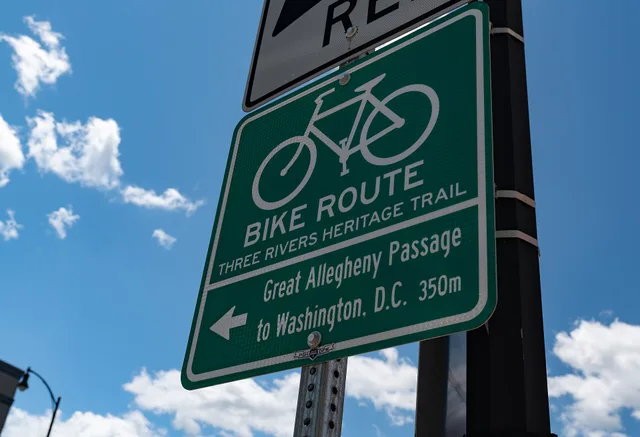
The Great Allegheny Passage runs about 150 miles between Pittsburgh and Cumberland on old rail beds. Crushed limestone, gentle grades, no cars.
The whole trail fits three riding days if you start in Cumberland and ride west, which puts the one real climb on the first morning.
Pittsburgh Weekend on GAP
- Fridayafternoon train, build bike, ride to Point, overnight
- Saturdayride east through Homestead, West Newton, Connellsville
- Sundayride back west to Pittsburgh or continue to Cumberland
Day by day:
- Friday. Amtrak to Cumberland, mid-morning arrival. Ride about 43 miles west to Meyersdale, over the Eastern Continental Divide and through the Big Savage Tunnel. Overnight in Meyersdale.
- Saturday. Ride about 46 miles to Connellsville, down the Casselman River and along the Youghiogheny. Overnight in Connellsville.
- Sunday. Ride about 61 miles into Pittsburgh, finishing at the Point. Overnight in the Strip District.
The Pennsylvanian east leaves Pittsburgh in the morning, so Monday is the travel day home.
Trail towns with beds close to the path include West Newton, Connellsville, Ohiopyle, Rockwood and Meyersdale. Ohiopyle sits inside a state park, so summer weekends there need booking months out.
Crushed limestone rolls slower than pavement, and western Pennsylvania gets afternoon thunderstorms from June through August. Set daily mileage lower than you would on a paved trail.
Read a two-day cycling itinerary built from the mistakes that end trips early, especially overbooked mileage and a skipped train check.
A weekend on the Erie Canalway Trail
The Erie Canalway Trail crosses New York State, roughly 360 miles between Buffalo and Albany, mostly stone dust and asphalt along the old canal corridor.
Buffalo to Rochester Weekend
- Fridaytrain to Buffalo
- Ride east to Rochester
- Sundaytrain home from Rochester
The train makes this corridor the easiest in the country for a car-free weekend. Albany-Rensselaer and Buffalo-Depew bracket the trail, and Syracuse and Rochester sit between them.
A plan that fits two days: train to Buffalo on Friday, ride east to Rochester, train home from Rochester. That is about 90 miles, split into two comfortable days.
Canal towns with lodging near the path include Lockport, Brockport, Pittsford and Palmyra. Pittsford and Brockport both have village centers a short ride from the trail.
The trail is flat, which suits loaded bikes and riders who have not trained much. The trade is wind. Open farmland along the canal delivers a steady headwind in either direction.
Spring and fall in upstate New York run cold and wet. Pack layers and expect one rainy stretch per weekend.
For how to pick a base town and what trail lodging actually provides, see where to stay on a rail trail trip.
The last mile from platform to trailhead
This is where car-free plans fail. A station two miles from the trailhead is fine on a bike and miserable with luggage and no plan.
Last Mile Checks
- Distance from platform to trailhead
- Route rideable with panniers
- Taxi or rideshare will take a bike
Pittsburgh to the Great Allegheny Passage is a short urban ride. Albany-Rensselaer to the Erie Canalway Trail means crossing the Hudson, so plan the bridge path or a shuttle.
Rideshare drivers often refuse bikes, and small-town taxi firms may have no rack. Call ahead and confirm, or book a shuttle that carries bikes.
Federal money builds many of these links. The FHWA Bicycle and Pedestrian Program publishes the planning and design resources behind them.
The Bureau of Land Management's Know Before You Go guidance is written for public lands, but the habit holds on rail trails.
USAGov's travel page covers documents and transport alerts.
Booking order, and what it does to the bill
Sequence changes both the cost and whether the trip works. Lock the fixed points, then the flexible ones.
Booking Order
- Check train times and bike space
- Book lodging next when town is small
- Book train once nights are fixed
- Book shuttle or taxi last
- Confirm everything a week out
Lead times are shorter than most riders expect. Bike racks on the East Coast trains hold a handful of bikes, so reserve the space when you book the seat. Use four weeks as a floor, and eight weeks for a holiday weekend.
Rooms in Ohiopyle or a state park go two to three months out for June through September.
What the bill looks like, as planning ranges:
- Fare. Washington to Cumberland runs about $25 to $45. Pittsburgh to Washington on the Capitol Limited runs about $60 to $130. Albany to Buffalo on the Empire Service runs about $45 to $75.
- Bike. Around $20 per bike per departure for roll-on space, paid with the ticket. A boxed bike checked as baggage costs a little more.
- Bed. $100 to $180 a night in most trail towns, and $150 to $250 in Ohiopyle or a park lodge in summer. Saturday runs $15 to $30 above the weekday rate.
Fares move with demand and with Amtrak's schedule updates, so treat the numbers as typical ranges, not quotes.
Weekend nights cost more than weeknights in trail towns, and fares climb as departure nears. Booking order quietly sets what a bike itinerary costs, which is why the sequence matters more than any single price.
The same logic carries into a realistic cycling weekend planned further out: fix stations and nights first, then build the riding around them.
Fallbacks when a train or trail segment fails
A canceled train, a washout closure or a storm day ends the trip only if you left no backup. Build these before you go.
Fallback Checklist
- Second train option same day or next morning
- Station within riding distance if planned one unreachable
- Taxi or shuttle number saved offline
- Shortened route that still reaches lodging
- Bailout town with hotel and station
- Cash for a fare if card readers fail
On the Great Allegheny Passage the bailout points are Pittsburgh and Cumberland, with Washington as a third through the C&O Canal Towpath. On the Erie Canalway Trail, Albany, Syracuse, Rochester and Buffalo all have train service.
If a train cancels, ask about the next departure and whether your bike space transfers. If a segment closes, check whether the road detour is signed and whether you want to ride it with traffic.
Car-free trips break more easily than car trips and run more predictably once the fixed points are set. Build around the train, keep one backup per leg, and the weekend holds.
Common questions
Do all Amtrak trains allow bikes rolled on?
No. Only trains fitted with bike racks take roll-on bikes, and not every route has them. Where a train has no rack, the bike travels boxed, checked as baggage, and only staffed stations handle that.
Which station is best for the Great Allegheny Passage?
Pittsburgh and Cumberland. Pittsburgh puts you at the western trailhead with the most fallback departures, and Cumberland drops you near the midpoint with a short ride to the path.
Can I ride the Erie Canalway Trail without a car?
Yes. Albany-Rensselaer, Syracuse, Rochester and Buffalo-Depew all sit on the Empire Service, and the trail passes near each. Ride one direction and train back.
What happens if my train is canceled?
Ask about the next departure and whether your bike reservation transfers. Keep a taxi number and a nearby hotel as backup, and know which stations you could ride to instead.