Guides
Part of 4 pointers on cycling trip mistakes that hold up
Cycling trip mistakes itinerary: a two-day planning framework
A cycling trip mistakes itinerary framework: check maintenance, budget junction time, set a drop-point rule, and finish before dark on a two-day ride.
Rather than planning a good two days and hoping, plan against the specific failures. The framework below is built backwards from the four things that most often end a trip: an unknown maintenance state, junction delays in town, running out of daylight, and a route with no way to shorten it. Each section gives you a check to run before you leave and a rule to follow on the day.
What to take away
- Assume the maintenance state of the corridor is unknown until someone tells you otherwise.
- Junction timing costs more than distance in and around towns.
- Finish the first day two hours before the light goes, not at the light.
- Design the route so a section can be dropped without breaking the plan.
Assume nothing about maintenance
Facilities degrade at a rate set by local budgets, not by how the trail was built.
Federal best practice on facility maintenance from the FHWA offers two points for a trip plan. Accessible design fails without maintenance. Implementing regulations under Title II of the Americans with Disabilities Act—28 CFR 35.133—require accessible features and equipment stay in operable working condition.
Whether that has happened on your corridor is a local question. Ask when the section was last inspected, not when it was built.
Budget time for junctions
The Manual on Uniform Traffic Control Devices (MUTCD) and FHWA guidance on signalisation for bicycle facilities describe bicycle signals that separate cyclists from turning traffic.
Junction vs corridor pace
Junction town miles
- Pace
- Roughly half
- Signal wait
- Several cycles
- Leading interval
- 3-5 seconds if installed
Corridor miles
- Pace
- Full pace
- Signal wait
- None
- Leading interval
- Not applicable
A leading bicycle interval gives three to five seconds of green before the vehicle indication, so riders become visible before traffic moves.
Three to five seconds is not much, and it only exists where it has been installed. Where it has not, a group crossing a junction takes several cycles. Budget accordingly: town miles run at roughly half the pace of corridor miles.
The two-day shape
| Time | Plan | Guards against |
|---|---|---|
| Day one, 9am | Leave from the door, not from a drive | Late start |
| Day one, midday | Longest block, on the corridor | Junction delays |
| Day one, 4pm | Arrive in the base town | Riding into dusk |
| Day one, evening | Confirm day two with a local | Stale information |
| Day two, 9am | Shorter loop or return leg | Fatigue |
| Day two, 1pm | Finished, with slack before travel | Missed connections |
Check the light before you leave
The two-hour margin needs a real clock time. The U.S. Naval Observatory's Sun and Moon data for one day provides rise, set and transit times for the Sun and civil twilight beginning and end times for a date and place. Before the trip, look up the base town for your ride date, write the sunset on the plan, and set the day-one arrival two hours earlier. On the day, the rule is simple: if the arrival time cannot be met, the drop point decides, not the light.
Confirm the evening before you ride
The table above assumes you arrive at a base town with a place to sleep and a meal waiting. Before you leave, call or check the lodging you have booked for the end of day one: confirm the room is available, ask whether there is a secure place to park a loaded bike overnight, and note the last kitchen or restaurant that will serve you at your expected arrival time. A two-hour daylight margin means nothing if the town's only eatery closes at five.
Build in a section you can drop
Choose a route where one segment can be cut without stranding you: a loop with a shortcut, or an out-and-back where turning early is always an option. That single feature converts most day-of problems from a crisis into a decision.
The check before you leave: trace the shortcut or the turnaround on a current map, confirm it is open, and note how far it leaves you from the base town. Mark the drop point on the plan, with a time attached. If you are not there by two in the afternoon, take the short version.
Decide that in advance, when nobody is tired and nothing has gone wrong. It beats deciding at a junction in the rain with a group waiting on an answer.
Worked example: the Elroy-Sparta State Trail
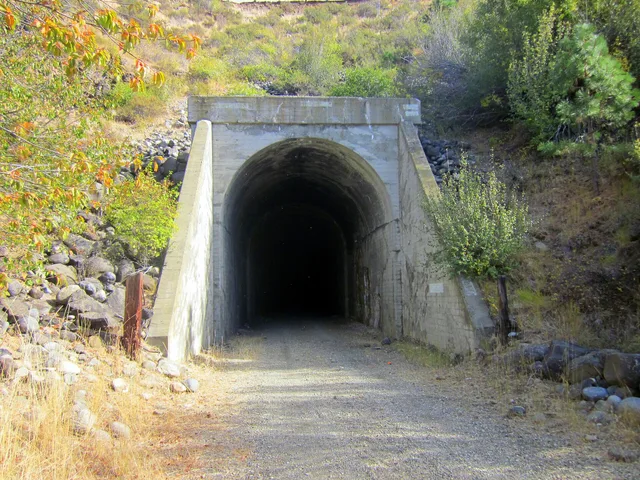
The framework is easiest to see on a short, well-served corridor. The Wisconsin DNR describes the Elroy-Sparta State Trail as the first rail-to-trail in the United States, with three rock tunnels and five small towns along its 32.5-mile route. Between Sparta and Elroy it passes through Norwalk, Wilton and Kendall, and a state trail pass is required for bicycling.
Applied to the four failure modes:
- Maintenancecheck the property notices on the DNR page before you leave, and ask about the tunnels as well as the surface.
- Junctionsthe town miles are at the two ends and in the three small towns between, so most of the day is corridor riding.
- Daylightride Sparta to Elroy on day one and look up sunset for Elroy, the base town; the DNR lists campgrounds at Elroy and Sparta.
- A section you can dropon the return, each of Kendall, Wilton and Norwalk is a place to turn back early, so day two can stop at any of them without stranding anyone.
Buy the trail pass and confirm the night's bed before the first pedal stroke, and the plan above is a full itinerary rather than a hope.
The causes this itinerary is designed against are set out in what causes cycling trip mistakes, and the general two-day structure it adapts is in a two-day rail trail itinerary.