Guides
Part of Getting rail trail travel right the first time
Mapping a two-day rail trail itinerary around access points and town spacing
How to build a two-day rail trail itinerary around access points, town spacing and crossings, with a worked shape you can adapt to any corridor.
What to take away
- Choose the start, overnight and finish towns before you think about mileage.
- Plan day one at 35 to 45 miles and day two at 25 to 35 miles on crushed limestone. Add roughly 10 miles per day on smooth pavement.
- Confirm how you get back to the car before you book a bed.
- Check open sections and surface with the managing agency in the week before you travel.
Where the three fixed points come from
A two-day trip has three positions you cannot move later: the start, the overnight town and the finish. Pick them off the trail map first, then measure the gaps between them.
Converted rail corridors run at a gentle grade. Daylight, food and road crossings set your limit rather than climbing, which is why town spacing decides how a day feels.
If the point-to-point shape is new to you, the rail trail travel starting point explains why one-way suits two days better than an out and back.
Example: two days on the C&O Canal Towpath
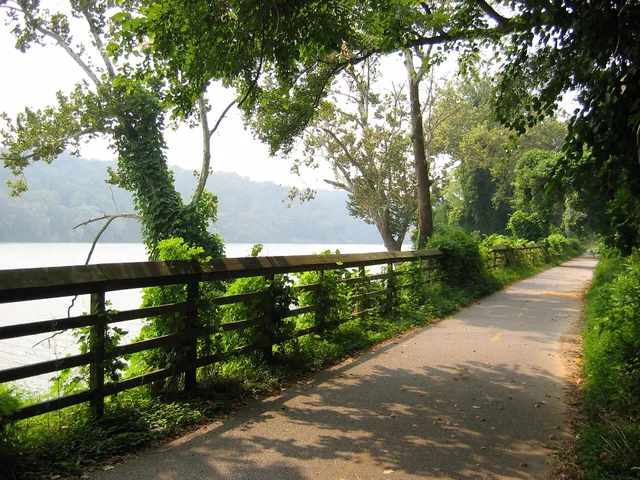
Harpers Ferry, West Virginia, to Hancock, Maryland, on the C&O Canal Towpath is about 63 miles of flat crushed limestone. Williamsport sits near the middle with beds and food, so it takes the overnight.
Day one runs about 39 miles west to Williamsport. Day two covers about 24 miles to Hancock, which leaves the shorter day for the leg that carries the return.
Two days on the C&O Canal Towpath
| Block | Riding time | Distance | Confirm before you go |
|---|---|---|---|
| Day one, morning | 3 to 4 hours | 20 to 25 miles | Water, first open section, parking receipt |
| Day one, afternoon | 2 to 3 hours | 14 to 19 miles | Arrival in town before food service ends |
| Day one, evening | None | 0 miles | Diner hours after 8pm, secure bike storage |
| Day two, morning | 2 to 3 hours | 14 to 19 miles | Shuttle or train time, checkout, breakfast |
| Day two, afternoon | 1 to 2 hours | 8 to 12 miles | Buffer for a late start or a mechanical |
The table carries the whole shape: about 8 to 12 hours of pedalling across two days, with the evening as a hard stop for food and resupply.
Route directness is worth checking before you commit. It is the ratio of trail miles to straight-line miles, and this corridor runs at roughly 1.8 to 1. The river meander explains why 63 trail miles cover only about 35 miles on a map.
[figure 1]
Two-Day Itinerary Shape
- Morning day oneLongest riding block
- Afternoon day oneApproach overnight town
- EveningRecovery and resupply
- Morning day twoShorter, return in mind
Mileage rules you can apply elsewhere
Use 35 to 45 miles on day one if you are comfortable riding 50 to 60 miles on pavement in a day. Crushed limestone costs speed, and every road crossing costs time.
On smooth pavement, plan 50 to 60 miles on day one and 35 to 45 on day two. After heavy rain on soft gravel, cut both figures by a quarter.
Day two stays shorter because it absorbs a late start, a slow breakfast and one mechanical. That margin is what gets you to the shuttle on time.
Check surface and open sections before you book
Surface sets your pace more than distance does, so ask the managing agency two questions. Which sections are open, and what the surface is like between your two overnight towns.
Trail rules are not uniform, and e-bike access varies by jurisdiction and by who manages the corridor. Check that before you plan around a throttle.
Drainage matters most on crushed limestone. The seasonal timing guide covers how melt and mud season hit northern corridors, and which weeks to avoid.
Call the agency in the week before you travel rather than the month before. Washouts and storm closures appear fast and clear slowly.
Getting back to the car
Transit first, because it is usually the cheapest option and the least dependent on demand. Harpers Ferry has rail service, so check Amtrak and commuter timetables before assuming that a car shuttle is the only way back.
A shuttle can be one driver with a trailer or a scheduled van, and the definition of a shuttle service is a short checklist for comparing quotes on the same terms.
Then work through these in order.
- Check whether a train or bus serves either end of the ride on your travel day.
- Call two shuttle operators and ask them to quote a fixed price and a pickup time.
- Ask the overnight town's bike shop or the trail friends group for a local driver.
- Leave the car where the parking policy is posted and overnight stays are allowed.
Agree the return before you pay a deposit on a bed. Accommodation is often flexible. A driver who does not answer the phone is not.
Parking rules vary by land manager, and the C&O Canal parking guidance shows the overnight restrictions to look for at access points. Read the posted signs at the lot you plan to leave the car in, and photograph them before you ride away.
[figure 2]
Return Logistics Options
- Book local outfitter shuttle in advance
- Leave two cars at each end
- Check public transport near either end
- Plan quiet-road loop if comfortable
- Confirm option before booking beds
Local operators know which shuttle actually turns up on a wet Sunday. The guide to finding reliable local information explains who to ask and what to ask them.