Maintenance
Part of Getting rail trail travel right the first time
Rail trail travel tips: 4 hazards first-timers miss
Rail trail travel tips for first-timers: road crossings, entrance bollards, surface changes and riding beside live track, and how to read each one.
A first rail trail ride usually goes well until it does not, and the failure points repeat. They are not fitness problems. They are design features — a road crossing, an entrance bollard, a change in surface, a stretch of live track beside the path — that a newcomer reads as scenery. These rail trail travel tips cover the four, and the federal guidance behind each one.
What to take away
- Road crossings are where the real risk sits, and no two are treated the same way.
- Posts and gates at trail entrances injure riders regularly and should never be treated as decoration.
- Surface can change at a county line without any warning on a map.
- On trails beside working railroads there is no standard separation distance, and some are very close indeed.
Crossings are the part to slow down for
The corridor is easy riding, which makes crossings dangerous. Attention drifts. The Federal Highway Administration (FHWA) treats each trail crossing as its own engineering question, not one template.
On a single trail you may meet a signalized crossing, an unsignalized one, and a section where users are routed to the nearest traffic signal. Those three demand different behavior from you.
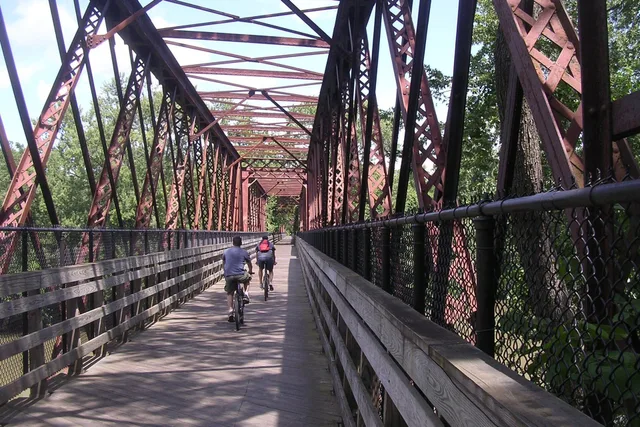
Read every crossing as a stop until proven otherwise. Sight lines on a rail alignment are often long in one direction and blocked in the other by embankment, vegetation or a bridge abutment.
Posts and gates at entrances
Trail managers sometimes install bollards or gates to keep cars out. The Federal Highway Administration is unusually direct about the cost in its recreational trail accessibility guidance on bollards and other barriers. Even correctly installed bollards are a serious and potentially fatal hazard to unwary trail users.
The same guidance notes that no arrangement admitting bicycles and trailers can exclude motorcycles, and that bollards should not be used at all without a documented history of unauthorized vehicle intrusion.
FHWA's guidance also names the second-user crash, where the leading rider hides the post until the rider behind has no time to react. Practical response: ride single file into every entrance and crossing, and never follow a wheel closely through a narrow point.
Surface is not one thing
A trail described as crushed stone may be firm and fast for twenty miles and soft for two. The Great Allegheny Passage, running between Cumberland, Maryland, and Pittsburgh, Pennsylvania, is packed crushed stone for most of its length. Paved sections often end at a jurisdictional boundary because a different agency funded that stretch, and the changes rarely appear on tourist maps.
Rides like
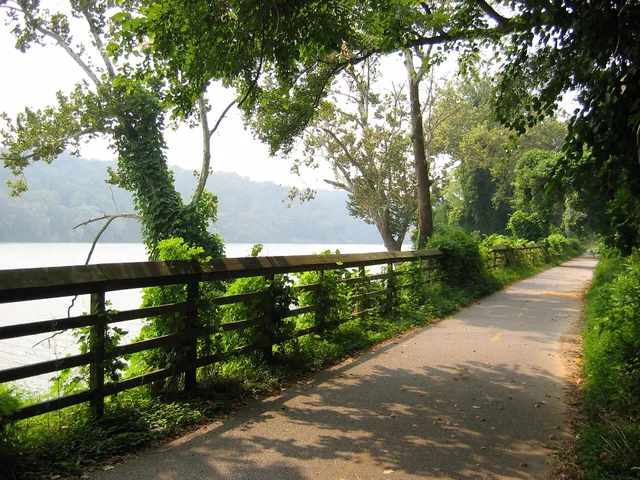
- Asphalt
- Fast, predictable
- Concrete
- Firm, consistent
- Packed crushed stone
- Slower, comfortable
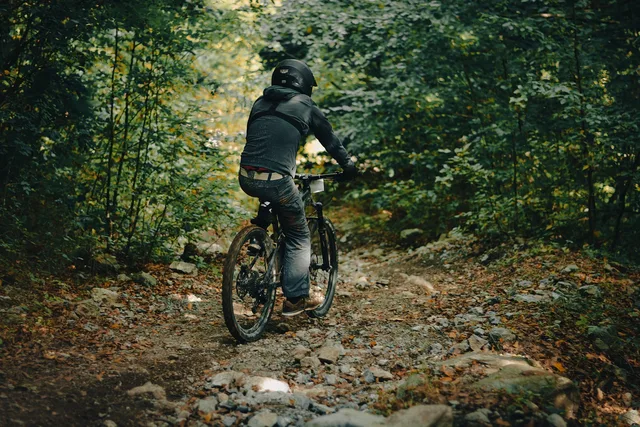
- Original ballast or dirt
- Unpredictable
Watch for
- Asphalt
- Frost heave, root damage, edge drop
- Concrete
- Joint spacing, slip when wet
- Packed crushed stone
- Softening after rain, loose new material
- Original ballast or dirt
- Standing water, ruts, walking pace
Trails beside live track
Where a path runs alongside a working railroad, the distance from the track is a local decision. FHWA's 2002 review, Rails-with-Trails: Lessons Learned, found that no national standards or guidelines dictate this design, so guidance has to be assembled from shared use path, pedestrian, railroad and crossing sources.
A constrained trail beside slow and infrequent trains might sit as close as ten feet from the track centerline. The report is blunt that derailment risk is real even at low train speeds. Stay on the trail side of any fence, and do not stop on the ballast for a photograph.
Related reading on Trail Town Scout: planning the start of a first rail trail trip and shaping two days on the trail.