Industry
Part of Getting rail trail travel right the first time
Rail trail travel places to stay: base towns and campsites
Rail trail travel places to stay: judge a base town by trailheads, services and parking, with named GAP and C&O towns, campsites and a canal lockhouse stay.
When it comes to rail trail travel places to stay, most advice stops at distance to the path, which is the least useful measure available. A room two hundred feet from the trail with nowhere to leave a bicycle is worse than a room a mile away with a garage, a late kitchen and a shuttle.
What to take away
- Judge a base town by trailhead facilities, services and transport links, not by how close the bed is.
- Trailheads with parking, restrooms and linkages are built deliberately and funded as trail projects.
- A town with a bike shop or rental operator solves problems a hotel cannot.
- A rail station near the trail changes what an itinerary can look like.
Trailheads are the real anchor
Trailhead and trailside facilities are not incidental. Under the federal Recreational Trails Program, development and rehabilitation of trailside and trailhead facilities and trail linkages is explicitly eligible, alongside maintenance of existing trails and assessment of trail conditions.
States administer their own programs, usually through a resource agency, so where the money went is a local decision with visible results.
For a traveler, that means the well-built trailheads cluster. Find the one with parking, water and a restroom, then look for lodging within a short ride of it.
What to check in a candidate town
What to check in a candidate town
- Secure bike storageask the property directly
- Late food servicecall, do not trust listings
- Bike shop or rentalphone the shop
- Parking rulesask the managing agency
- Transit stopcheck the operator timetable
| Feature | Why it matters | How to confirm |
|---|---|---|
| Secure bike storage | A bike left outside overnight is a lost trip | Ask the property directly |
| Late food service | Rural kitchens often close early | Call, do not trust listings |
| Bike shop or rental | Tubes, spares, a repair, a shuttle | Phone the shop |
| Parking rules | Overnight parking is often prohibited at trailheads | Ask the managing agency |
| Transit stop | Turns a loop into a point to point ride | Check the operator timetable |
Local operators fill the gaps
Businesses along a trail often hold safety information the agency never publishes. FHWA case studies on trails beside working railroads found that on one Pennsylvania corridor, local bike rental companies brief customers about the adjacent tracks before they set off.
The same case studies note trails that connect directly to commuter rail stations, a feature that makes a one-way ride practical.
Make the local shop part of your planning, not just a source of inner tubes. They know the mud, the detours, and the trailhead closed last month.
They know which properties in town take bicycles indoors. Hotel listings answer that badly; staff answer honestly on the phone. In a small town, that single call often decides where you book.
A rail trail worked through: the Great Allegheny Passage
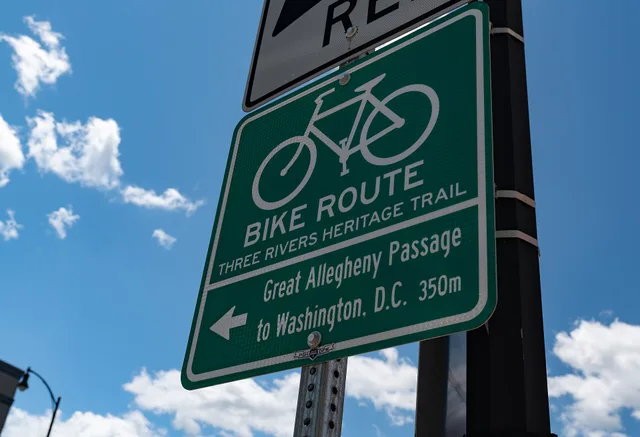
The Great Allegheny Passage is a 150-mile rail trail between Pittsburgh, Pennsylvania, and Cumberland, Maryland, built on a converted railroad grade, so the base-town question is exactly the one you ask on any rail trail. It is a Rail-Trail Hall of Fame inductee, and it includes the Montour Trail, a 52-mile branch that serves Pittsburgh International Airport.
Both end towns carry what the checklist asks about: places to stay, food and bike services. Pittsburgh is the city base, with the airport branch attached; Cumberland is smaller and sits where the passage meets the C&O Canal Towpath. Choosing between them is mostly a choice about which direction you ride.
Between the two, the passage's own trail towns split the ride into shorter days. Confluence and Ohiopyle, then Rockwood and Meyersdale in Pennsylvania, and Frostburg in Maryland, each put food and a bed within a short ride of the grade. Trail-town listings from the Great Allegheny Passage Conservancy name the services in each of them, which beats guessing from a map.
Together with the C&O Canal towpath, the passage is part of a 335-mile route between Pittsburgh and Washington, D.C., which is popular with through cyclists. That is the case where the base-town decision comes up every night of a through ride.
A second corridor: the C&O Canal Towpath
The C&O Canal Towpath, run by the National Park Service as Chesapeake and Ohio Canal National Historical Park, is a canal towpath rather than a rail trail, but the base-town checklist plays out the same way on it. The park is a 184.5-mile linear corridor between Washington, D.C., and Cumberland, Maryland, so the question comes up every night of a through ride.
The park lists several kinds of overnight stay. Private accommodations are available in many canal towns, and the park points riders to the Canal Towns Partnership to see what the towns along the towpath offer. The C&O Canal Trust's Canal Quarters program rents historic lockhouses along the canal. And the park runs hiker-biker campsites, which are free, first-come, first-served and limited to one night per site, per trip.
Parking is the other half of the plan. Overnight parking is allowed in designated parking areas anywhere in the park without a permit, but in the Washington, D.C. and Montgomery County, Maryland sections the park asks riders who leave a car overnight to send their license plate number, a description of the car and their return date to the park's permits office. The lots are not patrolled regularly, so nothing valuable stays in the car.
Three towns make natural bases because the park itself is anchored there. The canal begins at mile 0 in Georgetown, in Washington, D.C. Williamsport, Maryland, off I-81, holds the park headquarters and the Cushwa Basin Visitor Center. Cumberland, Maryland, off I-68, has the Cumberland Terminus Visitor Center at mile 184.5. Between them, the lockhouse stays include Lock House 10 in the Canal Quarters program, and the reservable drive-in campgrounds are Antietam Creek, McCoys Ferry, Fifteenmile Creek, Paw Paw Tunnel and Spring Gap.
Other canal towns work as bases too. Harpers Ferry, West Virginia, sits where the Shenandoah meets the Potomac, and Brunswick and Hancock in Maryland each have a town center a short ride from the towpath. The order of checks is unchanged: access point first, then the services, then the bed.
That is the whole method in one place: pick the access point, confirm the parking rule with the managing agency, then choose between a canal town bed in a base such as Williamsport or Cumberland, a lockhouse or a campsite.
A short booking sequence
- Fix the access points you plan to use.
- Ask the trail manager where overnight parking is legal.
- Choose the town, then the property.
- Confirm bike storage in writing.
- Confirm food and shop opening hours for your actual dates.
Access requirements come first, not last. The questions worth asking are in accessible rail trail travel, and the overall method sits in the rail trail travel starting point.