Guides
Part of Bike itinerary building: how it works, step by step
Bike itinerary building packing list for trail reroutes
A bike itinerary building packing list for trail reroutes, with repair gear, weather layers, hydration, safety items, offline navigation and contact backups.
For a bike itinerary building packing list, assume the plan may change and carry what you need to rewrite a day from a roadside in a place with one bar of signal.
What to take away
- Carry the information, not only the routephone numbers, opening hours and alternatives.
- Networks are actively being built and altered, so any map you carry is already out of date.
- Crossings vary in type along a single corridor, so carry what lets you stop safely at all of them.
- Power for navigation is a trip-critical item, not a convenience.
Carry current information, not old maps
The Active Transportation Infrastructure Investment Program, created by section 11529 of the Infrastructure Investment and Jobs Act, awards planning and design grants plus construction grants to build connected networks and spines. That work can change the network a trip depends on, but a grant announcement is not a closure notice: verify the section before riding.
That is good news for future trips, and a warning for this one. Sections open, close and change alignment while a printed map stays the same.
So carry the trail manager's phone number, the local shop's number, and the name of the person who told you a section was open. Those beat any map when something has changed.
Expect several kinds of crossing
The AASHTO Guide for the Development of Bicycle Facilities and Federal Highway Administration (FHWA) guidance describe distinct forms: trails intersecting other trails, bridges, streets and roadways, grade-separated crossings, and railroad crossings. Design guidance recommends crossings at right angles to maximize visibility. For packing, the takeaway is to carry lights and a basic repair kit and to check brakes and tires before riding.
What that means for kit is simple. You need to be visible and able to stop at every one of them, in whatever light you end up riding in.
Brakes and tires matter more than on a road ride at the same speed. A crossing asks for a controlled stop from whatever pace the corridor encouraged, often on a damp surface. It may have a timber deck or rubber flangeway insert.
Check pads before a trip with many crossings. Take the first few slowly as you learn how the surface behaves.
The list
| Item | Why it earns its place |
|---|---|
| Battery pack and cable | Navigation is what dies first |
| Offline map on the phone | Signal fails in cuttings and tunnels |
| Paper backup of the day's plan | Works when the phone does not |
| Front and rear lights | Crossings, tunnels, and late finishes |
| Written phone numbers | Manager, shop, lodging, taxi |
| Cash | Rural businesses and small shuttles |
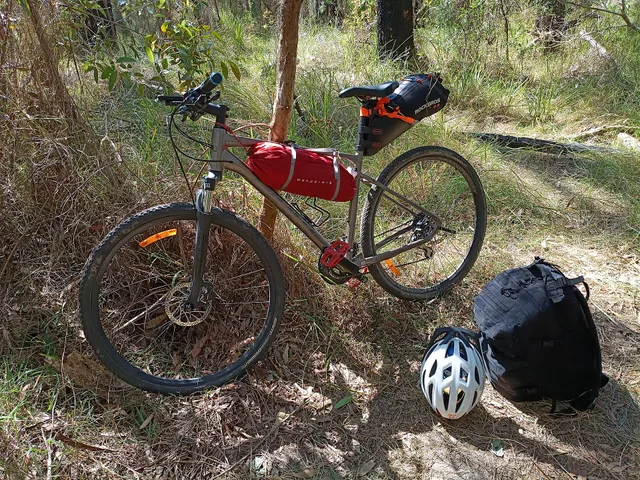
Alongside the navigation items in the table, pack the safety, repair, and comfort essentials below. Match spare parts to your bike, and choose layers and water for the route and forecast.
- A helmet that fits.
- Tire levers, a spare tube that fits your tire or a patch kit, and a pump.
- A multi-tool with the tools your bike needs, plus a chain tool if it is not included and chain lube.
- A first-aid kit.
- A rain jacket and weather-appropriate layers.
- Water bottles or a hydration system, plus food for the ride between stops.
- Personal identification and any medication you need.
- Front and rear lights, checked before departure.
- A paper note with the day's route, opening hours, trail-manager and local-shop phone numbers, and a verified fallback.
- Cash for rural shuttles, campsites, and honesty boxes.
What lets you change the plan
- Knowing which section can be cut without breaking the route.
- Knowing where the road alternative is, and how busy it is.
- Having a bed that can be moved, or a second option identified.
- Having enough daylight left, which means starting earlier than you need to.
The kit that suits mixed surfaces and town riding is covered in what to pack for a trail town trip, and the planning structure that this equipment supports is in how to build a bike itinerary.