Guides
Bike Parking at Trail Town Restaurants: A Practical Guide
Bike parking trail town restaurants: how to book a table, read opening hours, and pick a rack your loaded bike stays in sight of the whole meal.
What to take away
- A rack you can watch from your table beats a bigger rack around the corner.
- As a working rule, book 48 hours ahead on a normal weekend and seven days ahead in leaf season or on a festival weekend.
- Restaurant hours online go stale. The National Park Service posts seasonal hours for its trail visitor centers, and that page is the closest thing to a town clock.
- A stepped entry, a narrow stoop, or a no-bikes-inside sign is a hard stop, not a minor annoyance.
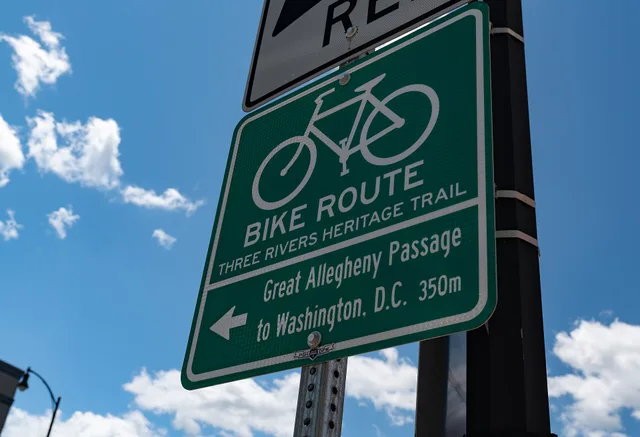
- Check the Great Allegheny Passage trail town listing at gaptrail.org before you ride the last hungry miles.
- You roll in tired, so settle the lock point before you order the meal.
Why sight lines beat rack counts
The restaurant with the prettiest patio may be the wrong one if its rack sits behind a dumpster. What matters is whether you can see the frame, both wheels and your lock from a window seat or a curb table.
A good lock point is an inverted-U staple rack bolted into the sidewalk in front of the window. A bad one is the wave rack at the far end of the block, out of sight from every table.
Published bicycle parking references classify racks by type and capacity, not by how easy they are to watch. A lock point you can watch often keeps a cycling trip from ending early.
Two towns, two lock points
Cumberland, Maryland. The Crabby Pig on Howard Street sits a block from the Canal Place trailhead, where the C&O Canal towpath meets the Great Allegheny Passage. Look for the inverted-U staple racks set into the sidewalk. If the rack in front is full, the next one around the corner costs you the sight line.
La Crosse, Wisconsin. Piggy's Restaurant on Front Street South faces Riverside Park, where the Mississippi River Trail runs along the river. Sidewalk staple racks keep the frame visible from a street-facing table. If no rack sits in view of the table, ride on.
What you have to book ahead
Trail towns run on a narrow clock. Cumberland, Maryland, fills its downtown tables on autumn weekends, when the C&O Canal towpath and the Great Allegheny Passage draw through-riders. La Crosse, Wisconsin, sees the same crush when Mississippi River Trail traffic peaks in late summer.
As a working rule, book 48 hours ahead for a standard weekend table. Book seven days ahead for leaf season, a festival, or a Saturday in a town with only a couple of sit-down restaurants near the trail.
A table for four is easier to get than a table for two at seven in the evening. Walk-ins with a loaded bike are the first turned away.
Peak season is also when bike itinerary building starts to matter. Overnight C&O Canal parking rules cover where a car may sit for a multi-day ride, not where a bike goes at lunch.
Opening times that catch people out
Kitchen hours are the trap. A restaurant that opens at 4 p.m. may not serve food until 5 p.m. Some kitchens stop taking orders 30 minutes before the posted close. A bakery that closes at 2 p.m. is gone by the time most riders roll in. Sunday and Monday closures are common in small trail towns. Check the door sign, not the search result.
The National Park Service posts the Cumberland Visitor Center's hours at Canal Place, a 9 a.m. to 4:30 p.m. day with holiday closures listed on the same page. That is the most reliable daytime clock in town when restaurant websites are months out of date. Call before you commit to a long detour.
The what to carry list for a changing itinerary starts with a lock and a snack.
If a town's only trailside restaurant closes at 3 p.m., arrive by 2 p.m. or carry food.
Access on arrival
Roll past the front door first. Then:
- Look for a rack, post or bolted bench inside the window line.
- Lock the frame and both wheels to a fixed object, never to another bike.
- Take panniers, lights and computers inside with you.
If the only fixture is a parking meter, a tree, or a loose planter, keep moving.
What is not accessible, stated plainly
A stepped entry with no ground-floor rack is a concrete barrier when you ride alone with a loaded bike. No lock point within sight means no meal there. Some doors carry a no-bikes-inside sign, and that ends the discussion.
A members-only dining room is closed to you without a member host. If the patio is fenced and the gate is latched from the inside, you cannot watch your bike, so you cannot eat there.
Who to contact when the site says nothing
Call the Cumberland Visitor Center at Canal Place, the trail office in town. Its staff cover the towpath and can point you to the doors on Howard Street and Baltimore Street where a bike stays in sight.
A shop that really knows your route can do the same. If nobody answers, check the trail town directory posted at the trailhead. Federal recreational trails funding pays for some of that signage.