Guides
Dog-Friendly Rail Trails and Trail Town Lodging: Where to Stay
Five dog friendly rail trails with named lodging that pass the room door to trail test, including Katy Trail, GAP, and Virginia Creeper. All pass the test.
What to take away
- The choice comes down to one measureminutes from the room door to the trailhead with the dog, on foot or by bike.
- Dog access is set by the managing agency, so rules can change where a trail crosses a park or county line.
- A ground floor room with its own outside door beats an upper floor pet room in a converted building.
The criterion that decides the stay
Dog-friendly rail trails and trail town lodging come down to one test: can you leave the room with the dog and be on the trail in ten minutes, without loading the car? Rates, pet fees and breakfast all rank below that single question.
Room-to-Trail Test
Passes test
- Trail access
- Walk from door
- Dog relief
- Grass in minutes
- Daily driving
- None added
- Walks
- On foot
Fails test
- Trail access
- Drive required
- Dog relief
- Car trip needed
- Daily driving
- 20-40 min added
- Walks
- Drive or shoulder
A dog that has ridden 20 miles needs to walk, sniff and relieve itself soon after the ride ends. That calls for shade and grass within a few minutes of the door.
A room far from the trail turns a simple need into a car trip, twice a day. Lodging that fails this test adds roughly 20 to 40 minutes of driving to each day, by the author's estimate.
Access rules are not uniform across a route. States, counties, park units and trail authorities each write their own terms, and the overview of rail trails notes that regulation varies by jurisdiction.
Five rail trail towns with dog-friendly lodging
| Rail trail | Trail town and state | Lodging that passes the walk test | Typical pet fee | Weight cap | Typical nightly rate |
|---|---|---|---|---|---|
| Root River State Trail | Lanesboro, Minnesota | Trestle Inn, pet friendly rooms near the trail | $20 to $40 per night | Often none | $120 to $220 |
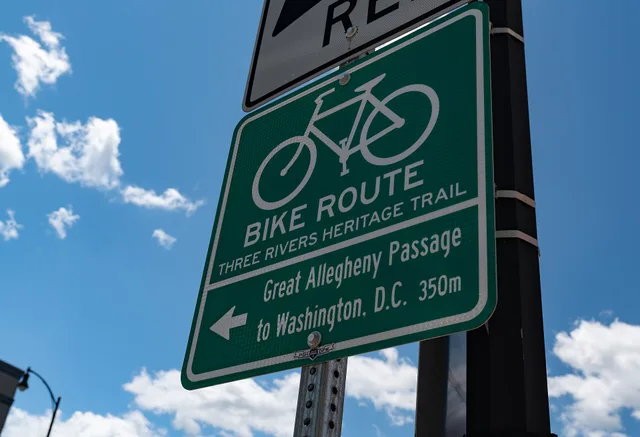
| Great Allegheny Passage | Cumberland, Maryland | Hampton Inn Cumberland, pet friendly rooms a short walk from the trailhead | $25 to $50 per stay | 50 pounds | $110 to $200 |
| Katy Trail State Park | Rocheport, Missouri | Katy Trail Bed and Breakfast, pet friendly rooms | $20 to $40 per night | Often none | $120 to $210 |
| Virginia Creeper Trail | Damascus, Virginia | Damascus Old Mill Inn, pet friendly rooms on the trail | $20 to $40 per night | Often none | $110 to $190 |
| High Bridge Trail State Park | Farmville, Virginia | Hotel Weyanoke, pet friendly rooms a short walk from the trail | $25 to $50 per night | 50 pounds | $120 to $230 |
These are typical ranges for peak season. Confirm current terms at booking.
Trestle Inn sits in a town where many shops and restaurants welcome dogs on patios. Hampton Inn Cumberland is about half a mile from the Canal Place trailhead for the Great Allegheny Passage.
Five Trails, Five Stays
Rail trail
- Root River State Trail
- Lanesboro, MN
- Great Allegheny Passage
- Cumberland, MD
- Katy Trail State Park
- Rocheport, MO
- Virginia Creeper Trail
- Damascus, VA
- High Bridge Trail
- Farmville, VA
Trail town
- Root River State Trail
- Trestle Inn
- Great Allegheny Passage
- Hampton Inn
- Katy Trail State Park
- Katy Trail B&B
- Virginia Creeper Trail
- Damascus Old Mill Inn
- High Bridge Trail
- Hotel Weyanoke
Lodging
- Root River State Trail
- Great Allegheny Passage
- Katy Trail State Park
- Virginia Creeper Trail
- High Bridge Trail
Katy Trail Bed and Breakfast is a short pedal from the Rocheport trailhead and offers bike storage. Damascus Old Mill Inn sits directly on the Virginia Creeper Trail and keeps a dog wash station. Hotel Weyanoke is a block from High Bridge Trail and charges a pet fee per night.
What to avoid in a motel district
Sidewalks are often absent, so each walk becomes a drive or a shoulder walk. You cannot leave the dog in the room while you ride, and you cannot tie it outside a cafe. Pet policies there tend to cap dogs by weight and charge per pet, per night.
Some of these properties sit beside federal land. There, leash and access rules come from the agency rather than the town, and the National Park Service page on where pets are allowed on federal lands sets out that boundary.
What to check before booking
- Is the pet fee per pet, per night, and does a weight or breed cap apply?
- Does the room open onto grass, or only onto a corridor?
- Can the bike sleep inside the room or in a locked cage?
- Which agency manages the trail, and what leash length does it require?
- How late can you cancel if flooding closes the path?
Leash rules trip up more bookings than anything else. A route can pass from town land to state park to federal ground in a few miles, and each manager writes its own terms.
The National Park Service caps leashes at 6 feet on most trails. State park systems in Minnesota, Maryland, Missouri and Virginia typically use the same 6 foot limit. Some county and town trails allow up to 10 feet.
Desk staff and shop mechanics also know which mile floods first. Who really knows your route covers how to find people who ride the path weekly.
For crushed limestone sections, pick the base to match the bike. The Crushed Limestone Rail Trails comparison covers what each surface does to a road bike across a full day.
What a distant motel costs in time
A motel out on the strip adds two drives a day, morning and evening, plus a third if the dog needs a midday break. At 10 to 15 minutes each way, that is 40 minutes to an hour gone, and the dog waits alone in a strange room between trips.
The hidden cost is distance cut from the ride. A 15 mile loop becomes a 10 mile loop, because the return drive is fixed. Shuttles can remove one of those drives.
River & Trail Outfitters runs a dog-friendly shuttle on the C&O Canal Towpath, with a typical one-way cost of $60 to $100. Bike Shuttle Services on Rail Trails explains what operators carry, how far ahead they book and what a one way run costs.
Booking lead times
Pet rooms are a small slice of inventory, so they go before standard rooms. On busy summer weekends along popular corridors like the Katy Trail or Great Allegheny Passage, book six to ten weeks out.
For fall color weekends on the Root River State Trail, four to eight weeks is often enough. Call the property instead of trusting a pet filter on a booking site.
Treat the room as part of the plan, not the last item on it. Choosing lodging sets out what separates a base that helps a trip from one that costs a day.